
Updated: September 2026
The top crypto market makers in 2026, judged on what a token issuer can verify, are led by Wintermute, GSR, Flowdesk and Keyrock, followed by a closely matched group of specialists. Every firm was assessed on the same public variables (venue coverage, deal-model disclosure, track record, client fit and regulatory standing), checked live against company websites and regulator registers in September 2026.
Disclosure: RGray is a crypto marketing agency and does not sell market making. One listed firm, BitQuant, is affiliated with us; its entry is labelled, and it was recorded on the same variables as every other firm.
Most rankings of the best crypto market makers stop at “deep liquidity” and “tight spreads”. That says nothing about what decides whether a launch goes well: the deal. So this guide compares the biggest crypto market makers without invented scores, explains the deal structures behind them and ends with questions for your first call.
Top Crypto Market Makers in 2026 at a Glance
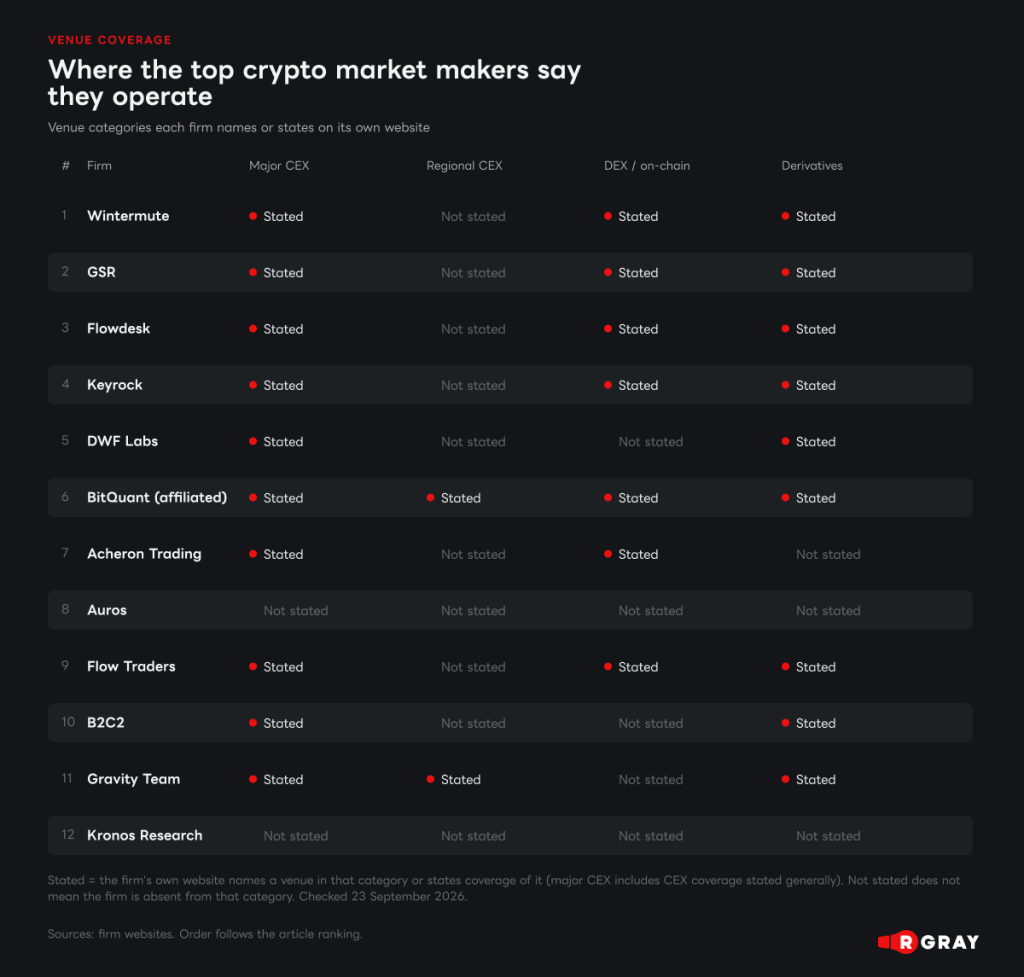
This crypto market makers list ranks firms by what an issuer can verify, not by reputation, which is why it reads differently from most rankings of the best crypto market makers. The table is a list of crypto market makers serving token issuers, in ranked order, with each deal model labelled by how public it is.
Top crypto market makers compared: coverage, deal model and regulation (checked 23 September 2026)
| Position | Firm | Venue coverage | Deal model (label) | Years active | Best-fit client type | Regulatory standing |
|---|---|---|---|---|---|---|
| 1 | Wintermute | 25 CeFi + 45 DeFi venues | Not disclosed | Since 2017 | Established tokens, DeFi protocols | FCA-registered (MLRs, UK); SEC-registered broker-dealer, FINRA member (US) |
| 2 | GSR | 60+ exchanges, CEX and DEX | Not disclosed | Since 2013 | Token issuers, exchanges, institutions | FCA-registered (MLRs, UK); MAS Major Payment Institution (Singapore) |
| 3 | Flowdesk | 150+ venues, CEX and DeFi | Publicly stated: loan (option or retainer), custodian or balance-sheet | Since 2020 | Issuers wanting a choice of structure | MiCA CASP (AMF, France); VARA licence (Dubai) |
| 4 | Keyrock | 85+ exchanges, CEX and DEX | Not disclosed | Since 2017 | European issuers; options and OTC needs | MiCA CASP (AMF, France) |
| 5 | DWF Labs | 60+ exchanges, spot and derivatives | Reported: market making plus OTC token investment | Since 2022 | Projects seeking capital plus liquidity | BVI VASP registration |
| 6 | BitQuant (affiliated) | Named CEX and DEX partner venues | Publicly stated: hybrid | Since 2017 | CEXs, DEXs, mid-tier token projects | None listed on its site |
| 7 | Acheron Trading | CEX and DEX; count not published | Publicly stated: loan + call option, or retainer + performance fee | Not disclosed | EU issuers | MiCA CASP (AFM, Netherlands) |
| 8 | Auros | 40+ venues | Not disclosed | Since 2019 | Projects wanting launch support plus liquidity | None listed on its site |
| 9 | Flow Traders (TradFi, crypto desk) | Named CEX, DEX and derivatives venues | Not disclosed | Since 2004 | Established assets, ETP and tokenized flow | AFM investment firm register (Netherlands) |
| 10 | B2C2 (SBI-owned) | Tier-1 CEX; spot and derivatives | Not disclosed | Since 2015 | Established and newly listed assets | MiCA CASP (CSSF, Luxembourg) |
| 11 | Gravity Team | 40+ venues incl. regional CEX | Not disclosed | Since 2017 | Exchanges, emerging-market and fiat pairs | None listed on its site |
| 12 | Kronos Research | 40+ exchanges (50+ on another page) | Not disclosed | Since 2018 | Protocol tokens, exchanges | None listed on its site |
Deal-model labels (the models themselves are explained further down):
- Publicly stated: the firm publishes its model or terms on its own site or in official materials.
- Reported: the model is described in credible third-party reporting or documented public deals, with a source link.
- Not disclosed: no public information. This is the norm in this industry and carries no negative implication.
Most firms land on not disclosed. Flowdesk, Acheron and BitQuant publish their models, and DWF Labs’ approach has been reported. None publishes fees.
How This List Was Built
We screened 20 firms: those most often searched for as top crypto market makers, plus BitQuant. Every site loaded with current content, so none was dropped as defunct. Eight were excluded for scope or data reasons:
- Jump Crypto, Jane Street, Virtu Financial and Cumberland (DRW): their sites do not describe a market making service for token issuers.
- Agora: an autonomous desk for tokenized stocks on Robinhood Chain, not an issuer service.
- Selini Capital: VARA-licensed, but its site describes no issuer-facing service.
- Amber Group and Kairon Labs: operating, but their sites gave no venue coverage or issuer-facing detail we could verify.
Ordering weighs verifiable scale and venue coverage first, deal-model transparency second, and track record and client fit third. Position is the only ranking signal. Positions 2 to 4 are closely matched, as are 6 to 8, where scale figures are self-reported and not comparable, so transparency did more of the ordering. From position 9 down, issuer offerings are narrower or less documented. Flow Traders is a traditional finance firm with a crypto desk, and B2C2 is owned by Japan’s SBI group; both are noted as such.
The list is selective, not exhaustive. It is re-reviewed annually, positions move as firms publish more, expand coverage or change terms, and firms not included may be added.
What “Largest” Means Here
The largest crypto market makers publish big, unaudited numbers: Wintermute cites $1T in cumulative liquidity, GSR over $1T traded, Auros $1.3T+ in year-to-date volume. Venue counts are defined differently too. We treat these as a floor for scale, not a leaderboard.
What Is a Market Maker in Crypto?
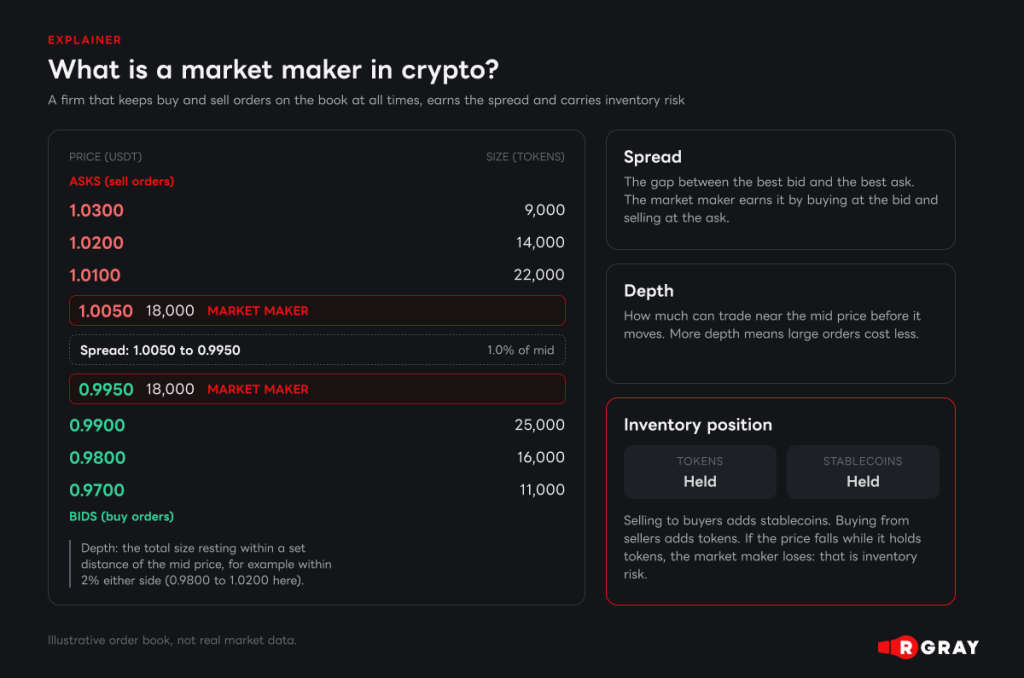
A market maker in crypto is a trading firm that keeps buy and sell orders on an exchange’s order book at all times, so anyone can trade a token without waiting for a counterparty. It earns the gap between its buy and sell prices, and in return it carries the risk of holding the token.
Three terms carry most of the weight:
- Spread: the gap between the best bid and the best ask. On a thin new token it can be several percent.
- Depth: how much can trade within a set distance of the mid price, usually 1% or 2% either side. Depth decides whether a fund can buy without moving the price against itself.
- Inventory risk: to quote both sides, the market maker holds your token and a stablecoin. If the price falls while it holds tokens, it loses. Spread income pays for that risk.
What Do Market Makers Do in Crypto, Day to Day?
They run quoting algorithms on every venue where your token trades, rebalance inventory between venues and arbitrage price gaps so your token costs the same everywhere. In volatile periods they widen quotes or cut size. A good one reports spread, depth, uptime and volume share on a fixed schedule.
They do not guarantee a price. A proposal that promises a price level, or volume unrelated to real two-sided quoting, is a red flag.
Why Exchanges Care at Listing
Exchanges want a new listing tradable from its first minute, because an empty order book is a bad product for their users. That is why the largest venues run their own market maker programs, covered below. Listing forms do not always ask: MEXC‘s public application does not mention market makers. In the launches I have worked alongside, though, the liquidity question almost always came up, and a named market maker was the expected answer.
How Crypto Market Maker Deals Are Structured
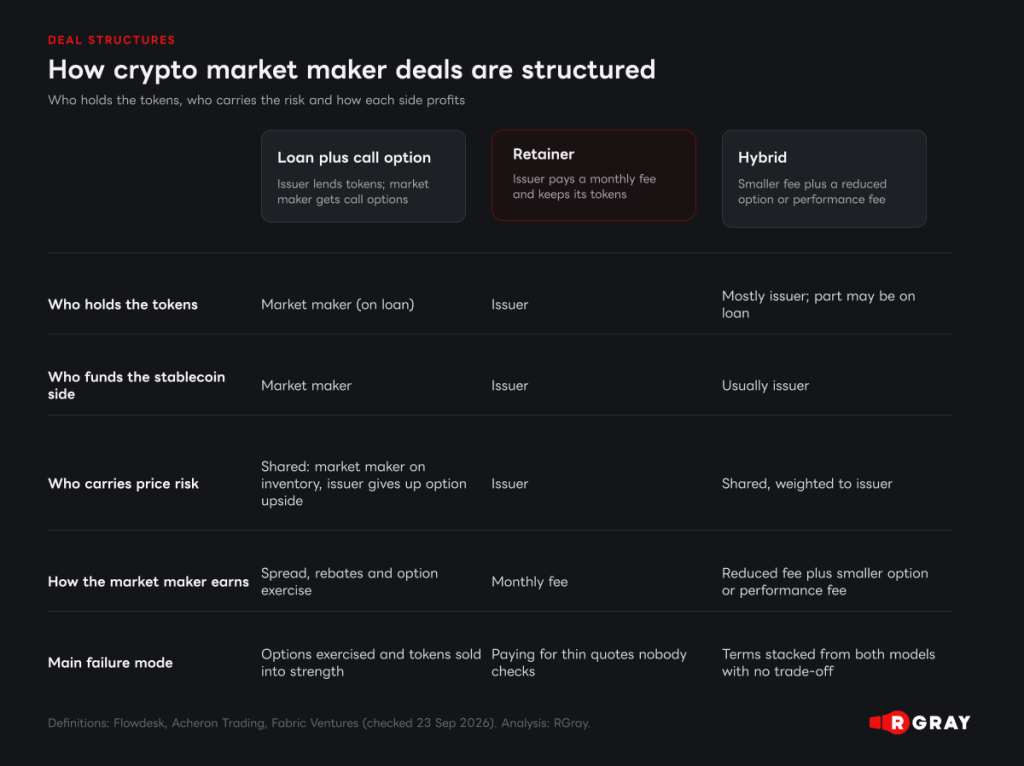
Crypto market maker deals come in three structures: a token loan with call options, a monthly retainer where the issuer keeps its tokens, or a hybrid. The structure decides who holds the tokens, who carries the price risk and how the market maker is paid, and it matters more than any spread target in the proposal.
Almost none of this is public. The Blockworks Token Transparency Framework has a section for market maker agreements, and its filings for WLFI and MANTRA both record that no market-making terms were disclosed.
Model 1: Token Loan Plus Call Option
The issuer lends the market maker tokens to use as inventory. The market maker supplies its own stablecoins and receives call options on the loaned tokens, carrying the capital risk and setting the strategy (Flowdesk). Fabric Ventures puts typical terms at 1% to 3% of circulating supply, a 6 to 12 month term and tiered strike prices.
On paper, incentives align: the market maker profits when the price rises above the strikes. In practice, the option gives it upside with limited downside. If the price climbs, it exercises, owns the tokens and may sell them, which lands as sell pressure just as the chart looks strongest. If the price falls, it returns what it still holds. Acheron, which offers this model, names lost upside and opaque strategy as the issuer’s drawbacks. Buyers, meanwhile, cannot see that part of the supply sits with a party that may sell, a gap Crypto Briefing examined in July 2026.
Terms to scrutinize:
- Strike prices: set against what? A strike at or below the listing price hands over upside from day one.
- Option size relative to the loan: if options cover the whole loan, every loaned token can be bought at the strike.
- Exercise style and term: American options can be exercised any time before expiry, European only at expiry.
- Return and clawback: what comes back at term end, and what happens if the market maker misses venue or uptime obligations.
Model 2: Retainer (Monthly Fee)
The issuer pays a monthly fee and supplies both sides of the inventory, which the market maker trades on its behalf. The issuer keeps the tokens and the price risk. Flowdesk calls this market making as a service (Flowdesk); Acheron calls it designated market making.
Published prices come mostly from vendors. OpenLiquid lists service fees of $3,000 to $15,000+ per month per centralized exchange, and Orca Bay works an example of $12,000 per month for three exchanges with $1 million of inventory. Treat these as orientation, not benchmarks.
The retainer is generally considered more aligned: the market maker holds no option, so its revenue does not depend on selling your token. The price of that alignment is that capital and risk sit with you. Retainers fail quietly: without venue-level targets (spread, depth at 2%, uptime) and live reporting, you pay for a promise.
Model 3: Hybrids and Variations
Hybrids mix the two: a smaller retainer with a reduced option package, a retainer plus performance fee (Acheron’s designated model), or a revenue share. The test is simple. Each unit of option you give away should buy a lower fee, and every performance fee should track a metric you can check on the exchange, not volume alone.
Crypto market maker deal structures compared
| Loan plus call option | Retainer | Hybrid | |
|---|---|---|---|
| Who holds the tokens | Market maker (on loan) | Issuer | Mostly issuer; part may be on loan |
| Who funds the stablecoin side | Market maker | Issuer | Usually issuer |
| Who carries price risk | Shared: market maker on inventory, issuer gives up option upside | Issuer | Shared, weighted to issuer |
| How the market maker earns | Spread, rebates and option exercise | Monthly fee | Reduced fee plus smaller option or performance fee |
| Main failure mode | Options exercised and tokens sold into strength | Paying for thin quotes nobody checks | Terms stacked from both models with no trade-off |
| Typical term | 6 to 12 months (Fabric Ventures) | Ongoing fee; check the notice period | Varies by package |
| Fits best when | Large token treasury, little stablecoin | Issuer can fund both sides and wants control | Issuer can fund part of the book |
The Economics an Issuer Has to Plan For
- Working capital: under a retainer you fund both sides. OpenLiquid estimates $20,000 to $40,000 per venue on MEXC, up to $100,000 to $200,000 on Binance.
- Cost of capital: inventory on exchanges is not funding runway and carries counterparty risk. Under a loan, the cost is the options you hand over. Compare both in dollars at several future prices.
- Exchange program requirements: exchanges set their own market maker obligations and rebates (see below), which feed your market maker’s economics.
- Engagement length: loan deals typically run 6 to 12 months. For retainers, check notice periods; OpenLiquid flags early-termination penalties of three to six months’ fees.
Stress Test: What October 2025 Showed
On 10 October 2025, more than $19 billion of leveraged positions were liquidated within 24 hours, the largest single-day liquidation in crypto history (CoinDesk). FTI Consulting found BTC top-of-book depth fell by more than 90% on key venues, as many market makers widened spreads or stepped away. That is how inventory risk behaves market-wide, not a finding against any one firm. It is why your contract should define quoting obligations in extreme volatility.
The Top Market Makers in Crypto, Reviewed
Each entry below records coverage, deal-model label, regulatory standing and a watch-out, in ranked order.
1. Wintermute
Founded in 2017, Wintermute publishes the broadest DeFi footprint on this list: 110 token liquidity partners, 25 CeFi exchanges and 45 DeFi venues. Wintermute Trading Ltd is on the FCA cryptoasset register (FRN 928764), and Wintermute USA LLC became an SEC-registered broker-dealer in August 2026 (BrokerCheck).
- Best for: established tokens and protocols with heavy on-chain liquidity needs.
- Coverage: 25 CeFi and 45 DeFi venues; spot, options, forwards and CFDs.
- Deal model: Not disclosed.
- Watch-out: the FCA entry is an anti-money-laundering registration, not a market making authorisation.
- Notable: a September 2022 DeFi hack cost about $160 million; the CEO said the firm stayed solvent (CoinDesk).
2. GSR
Active since 2013, GSR is the longest-running crypto-native firm here. GSR Markets UK Limited is on the FCA cryptoasset register (FRN 1018980), and GSR Markets Pte. Ltd. holds a MAS Major Payment Institution licence.
- Best for: issuers wanting a UK- and Singapore-registered counterparty plus launch advisory, added through its March 2026 purchase of Autonomous and Architech (GSR).
- Coverage: 60+ exchanges, CEX and DEX; spot and derivatives.
- Deal model: Not disclosed.
- Notable: a backer of the Transparency Alliance for token disclosures (CoinDesk).
3. Flowdesk
Flowdesk pairs the highest published venue count here, 150+, with a published menu of deal structures. It was founded in France in 2020. Flowdesk Europe SAS is MiCA-authorised by the AMF (ESMA), and Flowdesk Omega FZE holds a VARA licence.
- Best for: issuers who want to choose their structure and see inventory live.
- Coverage: 150+ venues, CEX and DeFi; OTC in spot and derivatives.
- Deal model: Publicly stated. Loan-based (option or retainer), custodian-based and balance-sheet structures (Flowdesk).
- Watch-out: Flowdesk discloses that over 20% of client orders route to an affiliate, Limitless Frontier, Corp. Ask how execution conflicts are handled.
4. Keyrock
Brussels-based Keyrock, founded in 2017 and backed by Ripple among others (Keyrock), draws data from 85+ exchanges. Keyrock FR SAS is MiCA-authorised by the AMF (ESMA).
- Best for: European issuers who want options and OTC alongside market making.
- Coverage: 85+ exchanges, CEX and DEX; options desk.
- Deal model: Not disclosed.
- Watch-out: get the proposed structure and venue targets in writing early.
5. DWF Labs
DWF Labs, founded in 2022 within Digital Wave Finance (DWF Labs), pairs market making with investment in the tokens it supports. It trades on 60+ exchanges, and DWF MaaS Limited is a registered VASP with the BVI Financial Services Commission.
- Best for: projects that want capital and liquidity from one counterparty.
- Coverage: 60+ exchanges, spot and derivatives.
- Deal model: Reported. The Block described its investments as OTC token purchases paid in tranches.
- Watch-out: if your market maker is also your investor, ask how quoting and its own position are separated.
- Notable: in May 2024 CoinDesk, citing The Wall Street Journal, reported on a Binance internal review of DWF Labs’ trading; Binance said the allegations were not substantiated and DWF Labs rejected them (DL News).
6. BitQuant
Disclosure: BitQuant is affiliated with RGray, the publisher of this article.
BitQuant is a B2B liquidity firm serving centralized exchanges, decentralized exchanges and token projects, in business since 2017 by its own account. It publishes its commercial model, though its verifiable footprint is smaller than the firms above.
- Best for: exchanges building order books, and mid-tier projects wanting CEX and DEX handled together.
- Coverage: named partner venues include Binance, KuCoin, Kraken, Bitfinex, Gate, Crypto.com, Indodax and Korbit, plus Uniswap and PancakeSwap; spot, futures and AMM management.
- Deal model: Publicly stated. Hybrid model.
- Watch-out: no published volume figures or licence. Ask for exchange references on your venues.
7. Acheron Trading
Acheron publishes both deal models side by side. Acheron Europe B.V. was authorised under MiCA by the Dutch AFM on 26 May 2025 (ESMA), which Acheron says made it the first dedicated market maker with that licence.
- Best for: EU issuers wanting a MiCA-authorised counterparty and a choice of structure.
- Coverage: CEX and DEX; no venue count published.
- Deal model: Publicly stated. Loan plus American call option (principal market making) or retainer plus performance fee (designated market making) (Acheron).
- Watch-out: no public venue list. Ask which exchanges are committed in the contract.
8. Auros
Founded in 2019 (Auros), Auros shows 40+ connected venues and positions itself as a partner from venture funding through launch and liquidity.
- Best for: projects that want launch support and liquidity from one firm.
- Coverage: 40+ venues; names and types not published.
- Deal model: Not disclosed.
- Watch-out: no licence listed on its site.
- Notable: Auros entered provisional liquidation after FTX’s collapse in 2022, restructured, and raised $17 million in March 2023 (CoinDesk).
9. Flow Traders
Flow Traders is a traditional finance firm with a crypto desk, founded in 2004 and listed on Euronext Amsterdam. It offers liquidity to crypto projects and exchanges (Flow Traders), and Flow Traders B.V. is on the Dutch AFM investment firm register.
- Best for: established assets with ETP, institutional or tokenized-asset flow.
- Coverage: names Coinbase, Deribit, Uniswap and Eurex among venue partners.
- Deal model: Not disclosed.
- Watch-out: crypto is one line of a multi-asset business; ask who covers your token.
10. B2C2
B2C2, founded in 2015 and owned by SBI Financial Services since 2020 (BusinessWire), is explicit about KPIs: uptime, spread and quote-volume targets are defined upfront (B2C2). B2C2 Europe Sarl is MiCA-authorised by Luxembourg’s CSSF (ESMA).
- Best for: established and newly listed assets wanting KPI-based quoting plus OTC.
- Coverage: tier-1 exchanges; spot and derivatives.
- Deal model: Not disclosed.
- Watch-out: institutional-only by design; smaller projects should confirm fit early.
11. Gravity Team
Gravity Team, founded in 2017 (Gravity Team), centres its offer on exchanges, especially emerging markets and fiat-quoted pairs, across 40+ venues.
- Best for: emerging-market exchanges and tokens that need fiat pairs.
- Coverage: names Binance, Coinbase, Kraken, Bitso, Bitkub, VALR and Bitbank; spot and derivatives (Gravity Team).
- Deal model: Not disclosed.
- Watch-out: confirm the issuer-side reporting you will get; no licence is listed on its site.
12. Kronos Research
Kronos, founded in 2018, offers designated market making, token market making and project token advisory. Its About Us page cites 40+ exchanges; another page says over 50.
- Best for: protocol tokens and exchanges looking for designated market making.
- Coverage: 40+ or 50+ exchanges; names not published.
- Deal model: Not disclosed.
- Notable: in November 2023 Kronos lost $26 million through compromised API keys; it said losses were covered internally (The Record).
Market Maker Programs on Crypto Exchanges
Market maker programs on crypto exchanges are rebate schemes an exchange offers trading firms in return for keeping quotes on its order books. They are not a crypto market maker service you hire; your market maker is usually the participant.
- Binance Futures: eligibility at 30-day volume above 1,000 BTC on spot or 3,000 BTC on futures, with weekly evaluation on maker volume, spread, order size and time in market; benefits are higher rebates and API limits (Binance).
- Bybit: spot tiers from $25 million in 30-day volume up to a 1% maker volume share, with maker rebates of 0.0010% to 0.0075% (Bybit).
- KuCoin: a two-month assessment-free period, rebates up to 0.012% and up to $3 million of interest-free credit for two to four months (KuCoin).
The difference is who the obligation is owed to. A crypto market maker program binds the market maker to the exchange across many pairs, with no commitment to your token. Your contract binds it to your token’s spread, depth and uptime. Ask which programs a firm joins on your venues, because those rebates are part of its revenue.
How Token Teams Should Choose a Market Maker
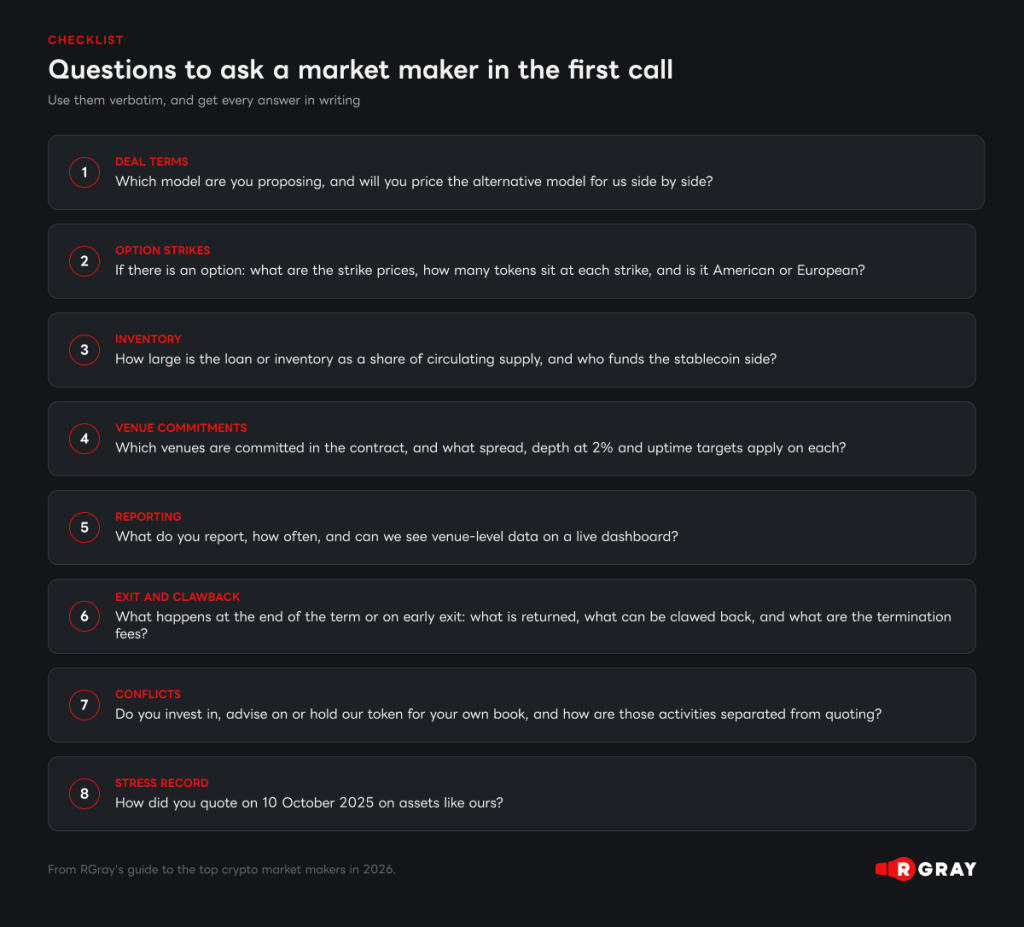
Choose on the deal first and the brand second, even among the top crypto market makers. Get every proposal in the same format, compare who holds the tokens and what each costs at several future prices, then ask these questions verbatim:
- Which model are you proposing, and will you price the alternative model for us side by side?
- If there is an option: what are the strike prices, how many tokens sit at each strike, and is it American or European?
- How large is the loan or inventory as a share of circulating supply, and who funds the stablecoin side?
- Which venues are committed in the contract, and what spread, depth at 2% and uptime targets apply on each?
- What do you report, how often, and can we see venue-level data on a live dashboard?
- What happens at the end of the term or on early exit: what is returned, what can be clawed back, and what are the termination fees?
- Do you invest in, advise on or hold our token for your own book, and how are those activities separated from quoting?
- How did you quote on 10 October 2025 on assets like ours?
[VISUAL 5: Checklist visual, PNG 2x | Questions to ask a market maker in the first call | The eight checklist questions verbatim from the article, each tagged by topic | Checklist showing how crypto teams choose a market maker: eight questions to ask in the first call]
Choosing for a New Token Launch
The best crypto market maker for new token launches is the one whose model fits your treasury, not the biggest name that takes the call. A team rich in tokens but short of stablecoins often defaults to a loan and option deal; if so, negotiate strikes well above the listing price and a partial option package. A team that can fund both sides usually gets better alignment from a retainer with published KPIs. For crypto market makers for token issuers at launch, venue commitments matter more than venue counts: 150 venues help only on the few where you list.
What Market Making Does Not Solve
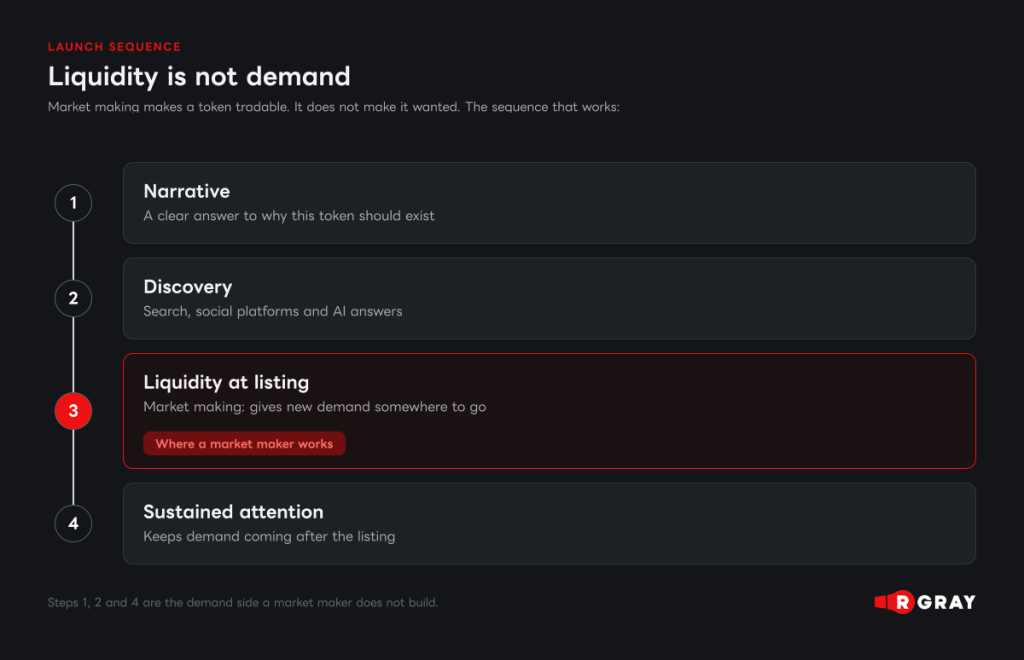
Liquidity is not demand. Market making makes a token tradable. It does not make it wanted.
A market maker can hold a tight spread on an order book nobody visits. When buyers are absent, the quotes simply meet sellers, and the market maker’s inventory absorbs them until its risk limits say stop.
The sequence that works is narrative first, then discovery, then liquidity at listing, then sustained attention after it. Narrative is a clear answer to why this token should exist. Discovery now happens in search, on social platforms and increasingly inside AI answers, which is why generative engine optimization belongs in a launch plan. Liquidity then gives new demand somewhere to go.
That demand side is what a crypto marketing agency is for, and it should be planned alongside your market maker, not after. If you are building a launch now, our approach to token launch marketing sequences both, and our guide to choosing the best crypto marketing agency applies the same diligence as the checklist above.
This article is for information only and is not financial, investment or legal advice.
FAQ
What Is a Market Maker in Crypto?
A market maker in crypto is a trading firm that keeps buy and sell orders on an exchange at all times so a token can be traded instantly. That is also the short answer to how do crypto market makers work: they quote both sides, earn the spread and manage the risk of holding inventory.
How Do Crypto Market Makers Make Money?
They earn the spread between buy and sell prices, plus maker rebates from exchange programs. Under a loan and call option deal they also profit by exercising options above the strike. Under a retainer, the monthly fee is the main income and the issuer keeps the trading risk.
How Do Crypto Teams Choose a Market Maker?
Crypto teams choose a market maker by comparing deal structures first: who holds the tokens, who carries price risk and what each proposal costs at several future prices. They then check venue commitments, KPIs, reporting, exit terms and conflicts of interest, with regulatory standing as a final filter.
How Much Does a Crypto Market Maker Cost?
Most firms do not publish prices. Vendor-published retainer ranges run from $3,000 to $15,000+ per month per centralized exchange (OpenLiquid), plus the working capital the issuer supplies. Under a loan and option deal the cost is the option value given away, which can exceed any retainer if the price rises.
What Is the Difference Between a Market Maker and a Liquidity Provider?
The terms are often used interchangeably in crypto. Strictly, a market maker quotes both sides continuously under agreed obligations, while liquidity provider also covers OTC desks and deposits into DEX pools. Every market maker provides liquidity; not every liquidity provider makes markets.
Do New Tokens Need a Market Maker to Get Listed?
Not always as a formal rule: MEXC’s public listing form, for example, does not ask about market makers. In practice, exchanges want new listings tradable from day one, and a named market maker is the usual way to show that. A team listing on several exchanges at once will struggle to keep prices aligned without one.
Planning a launch and want the demand side built alongside your liquidity? Book a free launch-marketing consultation with RGray at rgray.io.