
Updated: July 2026
Generative engine optimization (GEO) is the practice of getting your brand cited inside the answers that AI engines write, including ChatGPT, Perplexity, Google Gemini, Claude, Grok, Microsoft Copilot and Google’s AI Overviews. Traditional SEO works to rank a page in a list of links; GEO works to make your content the source an AI model retrieves, trusts and names when it composes an answer.
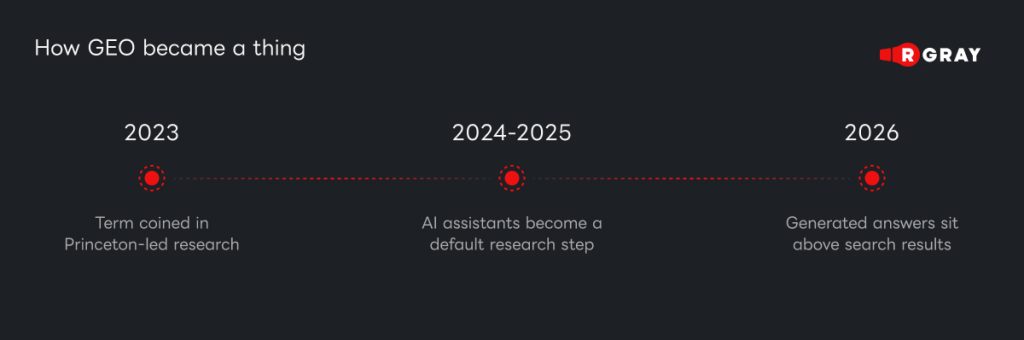
The term exists because the destination changed. A Princeton-led research team coined it in a 2023 paper (presented at KDD in 2024) that tested how editing a page changed its visibility inside generated answers. It stayed academic until 2025, when AI assistants became a default research step and Google started placing generated answers above its own results. By 2026 the question founders ask us is not whether buyers use AI to research vendors. It is whether the AI names them.
Why generative engine optimization matters in 2026
Generative engine optimization matters because a growing share of buying research now ends inside an AI answer instead of on your website. If the answer does not mention you, you were never in the consideration set, and ranking will not fix that.
Two numbers frame the shift. In February 2024, Gartner projected that traditional search engine volume would drop 25% by 2026 as AI chatbots absorb queries. Analysts argue about the exact figure, but the direction has held. The harder number comes from clickstream data: SparkToro‘s 2026 study found fewer than one in three Google searches sends a click to the open web, down sharply from 2024.
Buyer behaviour changed underneath. Instead of running five searches and opening twelve tabs, a founder evaluating a vendor asks one question and gets three named companies with reasons attached. That shortlist reads as a recommendation rather than a ranking, and most people never scroll past it. This is why AI search marketing has become its own discipline.
How AI engines choose what to cite
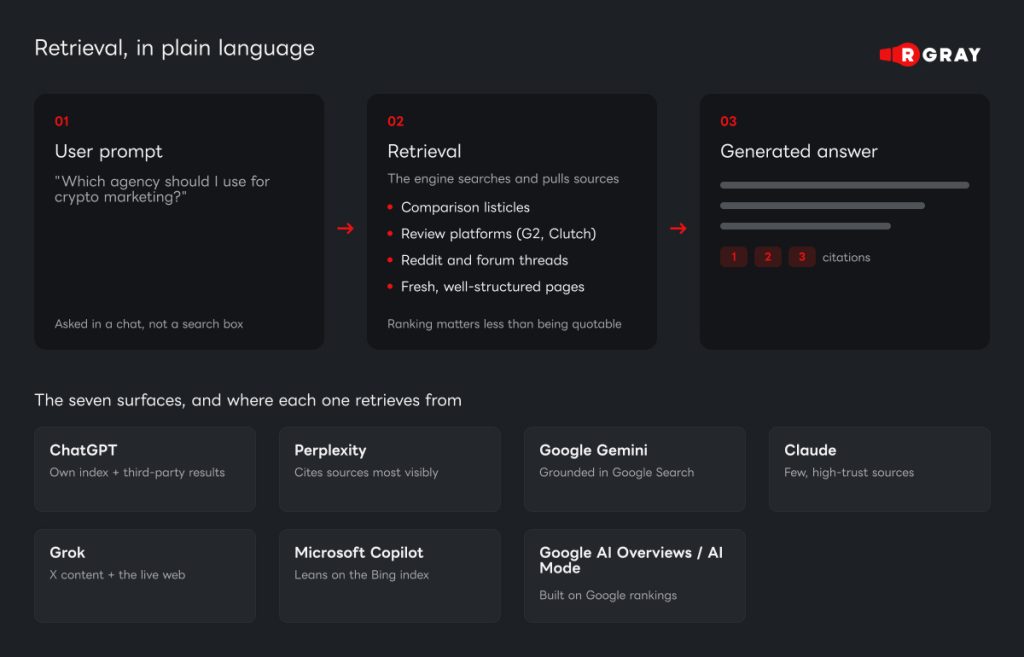
AI engines cite sources they retrieve at the moment of the prompt, favouring pages a claim can be lifted from cleanly: comparison listicles, review platforms, forum threads with real opinions, and fresh, well-structured pages from sites the engine already treats as credible.
Most engines do not answer from memory. They run searches behind the scenes, pull a handful of pages, and write an answer grounded in what they pulled. That step is called retrieval, and it means your ranking matters less than whether your page is easy to retrieve and quote. Where each surface retrieves from differs, and the differences are practical:
- ChatGPT combines its own index with third-party results, leaning on established publishers, review platforms and comparison pages.
- Perplexity shows its sources most visibly, usually five to ten per answer. The cheapest way to see what an engine finds authoritative in your category.
- Google Gemini grounds answers in Google Search, so pages that already rank start ahead.
- Claude searches the web when a question needs current information and cites a small number of high-trust sources.
- Grok leans on X content alongside the live web, so what is said about you on X shapes what it says about you.
- Microsoft Copilot leans on the Bing index. Bing rankings and Bing Webmaster Tools matter more here than most teams assume.
- Google AI Overviews and AI Mode are built on Google’s ranking systems, so classic SEO feeds them directly. Rank on page one and you are already a candidate source.
So GEO is not one channel, and third-party pages matter as much as your own. Asked to recommend a vendor, an engine usually retrieves a ranked listicle rather than a vendor homepage. A roundup like our best crypto marketing agency comparison is exactly that kind of page, so getting listed on credible roundups is a GEO tactic, not a PR afterthought.
Generative engine optimization vs traditional SEO
The difference in generative engine optimization vs traditional SEO is the unit of success: SEO wins a position on a results page, GEO wins a mention inside a generated answer. Both depend on the same crawlable, credible content, which is why they are complements rather than substitutes.
Answer engine optimization (AEO) sits between them: the older practice of formatting content to win featured snippets and answer boxes. Its habits (clear questions, short answers, structured data) carry over to GEO almost intact.
| Traditional SEO | AEO | GEO | |
|---|---|---|---|
| Goal | Rank a page for a query | Win the answer box or snippet | Get cited inside a generated answer |
| Where results appear | Blue links on a results page | Featured snippets, People Also Ask, voice answers | ChatGPT, Perplexity, Gemini, Claude, Grok, Copilot, Google AI Overviews and AI Mode |
| Key tactics | Keywords, backlinks, technical health, content depth | Question-led headings, concise answers, FAQ and HowTo schema | Entity consistency, quotable formats, presence in retrieved third-party sources, llms.txt and schema, citation tracking |
| How success is measured | Rankings, organic sessions, conversions | Snippet ownership, zero-click impressions | Citation share (how often you are named), sentiment of the mention, referral traffic from AI engines |
| Timeframe | 3 to 9 months | 1 to 3 months | 4 to 12 weeks for early citation movement, longer for competitive categories |
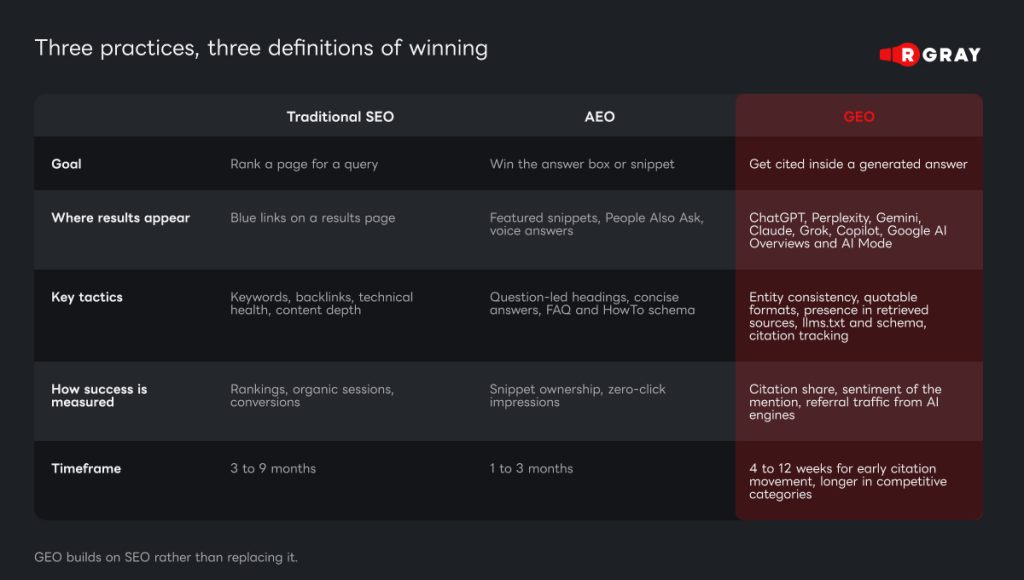
GEO builds on SEO rather than replacing it. Every engine above retrieves from the open web, and the pages that get retrieved are, with few exceptions, the ones already technically sound, well linked and worth reading.
GEO best practices and strategies
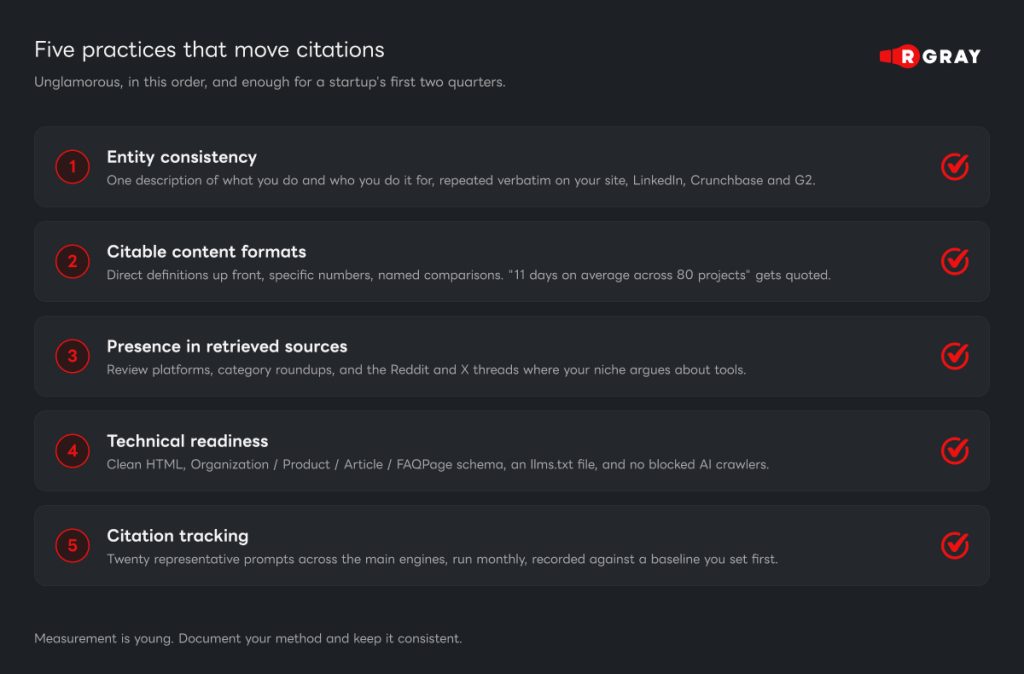
The generative engine optimization geo best practices that move citations are unglamorous: be described consistently, be easy to quote, be present where engines look, be technically readable, and measure what you get. These five generative engine optimization strategies cover most of what a startup needs in its first two quarters.
1. Entity consistency. Models build a picture of who you are from every mention of you across the web. If your homepage says “growth marketing agency”, your LinkedIn says “digital studio” and Crunchbase says “consultancy”, the model has three weak signals instead of one strong one. Pick one description and repeat it verbatim everywhere.
2. Citable content formats. Write answers a model can lift in one piece: a direct definition in the first two sentences of a section, specific numbers, named comparisons, dated claims. “Our onboarding takes 11 days on average across 80 client projects” gets quoted. “We onboard clients quickly” does not.
3. Presence in the sources AI engines retrieve. Audit which pages get cited for the ten prompts your buyers would actually type, then work to appear on them: review platforms (G2, Clutch, DeFiLlama for protocols), category roundups, and the Reddit and X threads where your niche argues about tools.
4. Technical readiness. Serve clean HTML, keep content out of JavaScript-only rendering, add Organization, Product, Article and FAQPage schema, and publish an llms.txt file at your root: a plain-text map pointing AI crawlers to your best pages, the way robots.txt points search crawlers. Also confirm you are not blocking GPTBot, PerplexityBot or ClaudeBot, which we still find on a third of the sites we audit.
5. Citation tracking. Set a baseline before you change anything: run twenty representative prompts across the main engines, record whether you appear and in what light, repeat monthly. Purpose-built GEO trackers exist and are worth testing, but a spreadsheet and a disciplined monthly run is enough to start.
Who needs GEO (and who can wait)
GEO pays off fastest for companies whose buyers research before they buy and whose category is crowded enough that a shortlist matters: crypto, Web3, SaaS, fintech and B2B services. Local businesses with short consideration cycles can reasonably wait a quarter or two.
Crypto and Web3 projects have an extra reason to move early. Their buyers are unusually likely to ask an AI engine whether a protocol is legitimate before touching it, and the sources engines retrieve (Reddit threads, X posts, audit summaries) are where reputation damage lives. Getting ahead of that is the core of crypto AI SEO work, and it is defensive as much as promotional.
The honest caveat: GEO measurement is young. Citation share is not a standardised metric, engines change retrieval behaviour without notice, and attribution from an AI answer to a signup is imprecise. Anyone, including a generative engine optimization agency, who promises a fixed number of citations by a fixed date is guessing.
How RGray applies GEO
We have run growth marketing for 80+ startup and crypto projects, and our founder spent ten years in crypto marketing, including time at Hacken. We treat GEO as an extension of the SEO and PR work we already do rather than a separate product: same entity work, same content, aimed at new destinations. Every engagement starts with a citation baseline, because without one there is nothing to compare against in month three.
FAQ
Generative engine optimization (GEO) is the practice of getting your brand cited inside the answers AI engines generate, such as ChatGPT, Perplexity, Google Gemini and Google’s AI Overviews. It combines entity consistency, quotable content formats, presence in the third-party sources engines retrieve, and technical readability for AI crawlers. The goal is to be named in the answer, not only to rank.
Traditional SEO aims to rank a page in a list of links; GEO aims to make your content the source an AI engine cites in a generated answer. SEO is measured in rankings and sessions, GEO in how often and how favourably you are mentioned. The two share a foundation, since engines retrieve from the open web SEO already optimises.
No. Google’s AI Overviews and AI Mode are built on Google’s ranking systems and Copilot leans on the Bing index, so classic search visibility feeds AI answers directly. GEO adds a layer on top by targeting surfaces SEO alone does not reach, such as ChatGPT, Perplexity and Grok.
Expect four to twelve weeks before citations move on prompts you were absent from, assuming technical and entity foundations are fixed early. Competitive categories take longer, and results are uneven: Perplexity often reflects changes within weeks, while AI Overviews follow slower ranking cycles. Anyone quoting a guaranteed timeline is overselling.
The working standard is citation share: run a fixed set of prompts across the main engines on a schedule, record whether your brand is mentioned and in what light, and track the trend. Supplement that with referral traffic segmented by AI engine and with branded search volume, which tends to rise as citations increase. Measurement is young, so document your method and keep it consistent.
The working standard is citation share: run a fixed set of prompts across the main engines on a schedule, record whether your brand is mentioned and in what light, and track the trend. Supplement that with referral traffic segmented by AI engine and with branded search volume, which tends to rise as citations increase. Measurement is young, so document your method and keep it consistent.
Want to know whether AI engines mention you?
We will run a free AI-visibility check across ChatGPT, Perplexity, Gemini and Google AI Overviews and show you where your brand does and does not appear: book a free AI-visibility check.