
Updated: August 2026
Most crypto projects spend between $3,000 and $50,000 per month on marketing in 2026, and a full token launch cycle costs $25,000 at the lean end to $600,000 or more for an aggressive multi-market push. What moves your number inside that range is scope (how many channels you run at once), agency seniority, and where the market is in its cycle, since KOL and paid media rates climb 30 to 50 percent in a bull run.
This guide gives you the actual figures. You get a cost table by service line, a token launch budget broken down by phase for three spend tiers, real published prices from named agencies, an agency vs in-house comparison, a lean playbook for pre-seed teams, and the pricing red flags we see most often. Prices are mid-2026 and shift with market conditions.
Crypto marketing cost at a glance
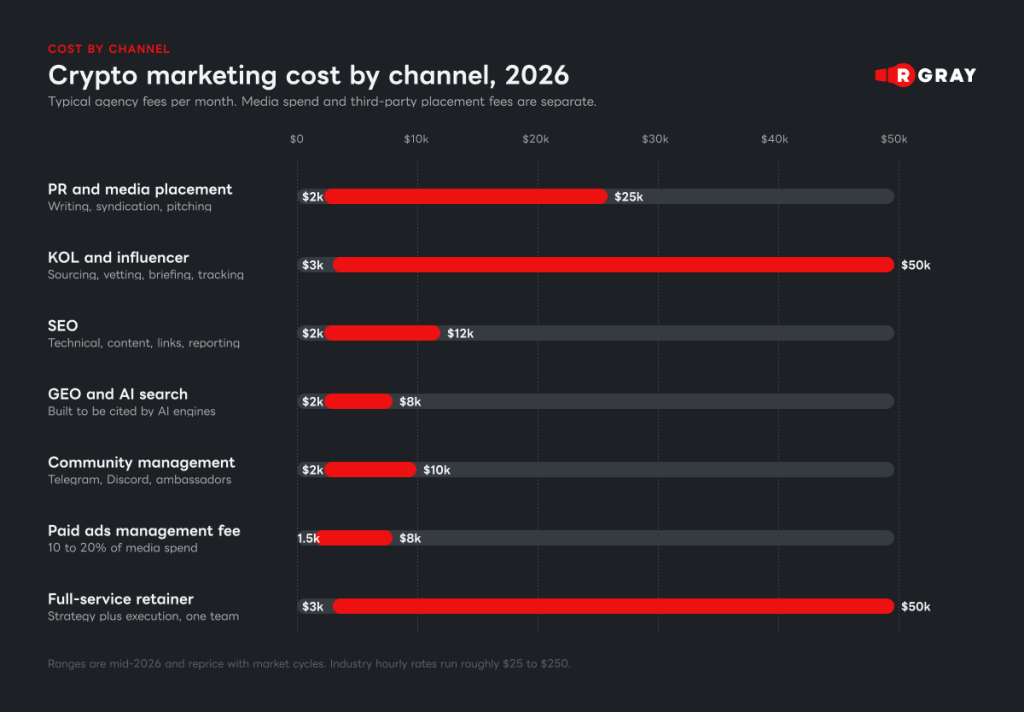
A single channel handled properly costs $2,000 to $12,000 per month. A full-service retainer that covers strategy, content, PR, community and search runs $3,000 to $50,000 per month depending on who you hire. The table below is what we quote and what we see clients pay across the web3 market.
Table A: Cost by service line (monthly)
| Service line | Typical monthly range | What is included |
| PR and media placement | $2,000 to $25,000 | Press release writing, syndication, tier-1 and tier-2 crypto media pitching, founder interviews. Paid placement fees are usually extra. |
| KOL and influencer marketing | $3,000 to $50,000 | Sourcing, vetting, negotiation, briefing, scheduling, performance tracking. Creator fees sit on top for most agencies. |
| SEO | $2,500 to $12,000 | Technical fixes, keyword and cluster strategy, 4 to 12 articles per month, link acquisition, reporting. |
| GEO and AI search | $2,000 to $8,000 | Content built to be cited by ChatGPT, Perplexity and Google AI Overviews. Entity and citation work, prompt-level tracking. |
| Community management | $2,000 to $10,000 | Telegram and Discord moderation, ambassador programs, event calendar, sentiment reporting. Round-the-clock coverage costs more. |
| Paid ads management | $1,500 to $8,000 fee | Campaign build and optimization on crypto-compliant networks. Fee is typically 10 to 20 percent of media spend, which is separate. |
| Full-service retainer | $3,000 to $50,000 | Strategy plus execution across most of the above under one team and one report. |
Three factors move your position in these ranges.
Scope. Every added channel adds coordination cost, not just delivery cost. Running PR, KOLs and community together costs more than the sum of the three quoted separately, because someone has to sequence them.
Agency seniority. The published spread is wide. Industry hourly rates run roughly $25 to $250. NinjaPromo sells subscriptions from $3,200 per month. TokenMinds sets a $5,000 minimum at $50 to $99 per hour. Coinbound starts at $10,000 per month at $100 to $250 per hour. MarketAcross also starts at $10,000 at $150 to $199 per hour, and OMNI at $10,000 at $100 to $149 per hour. Serotonin and EAK Digital sit higher, roughly $15,000 to $50,000 and $20,000 to $60,000 or more per month. RGray retainers start at $3,000 per month.
Market conditions. Your crypto marketing cost is not fixed across a cycle. In a strong market, KOL rates, listing fees and paid inventory all reprice upward within weeks. The same campaign that cost $40,000 in a flat quarter can cost $60,000 three months later. Budget in ranges, not fixed line items.
Cost of marketing for crypto token launch in 2026
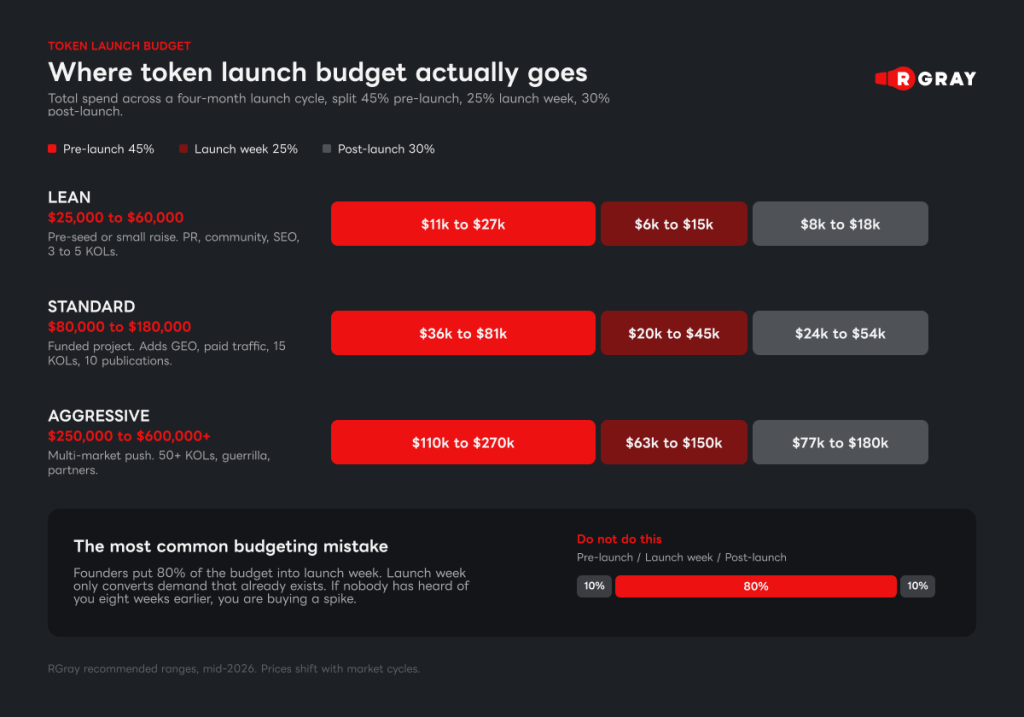
A token launch costs $25,000 to $60,000 all-in on a lean plan, $80,000 to $180,000 on a standard plan, and $250,000 to $600,000 or more on an aggressive one. These are total figures across the whole launch cycle, roughly four months, not monthly retainers. The cost of marketing for crypto token launch work is driven mostly by how many markets you enter at once and how much paid media you buy in the two weeks around TGE.
We split the cycle 45 percent pre-launch, 25 percent launch week, 30 percent post-launch.
Table B: Token launch budget by phase
| Phase | Lean ($25k to $60k) | Standard ($80k to $180k) | Aggressive ($250k to $600k+) |
| Pre-launch (8 to 12 weeks): positioning, site, docs, SEO and GEO foundation, community build, first PR wave | $11,000 to $27,000 | $36,000 to $81,000 | $110,000 to $270,000 |
| Launch week: coordinated PR push, KOL wave, listing and rating platform promo, paid traffic, AMAs | $6,000 to $15,000 | $20,000 to $45,000 | $63,000 to $150,000 |
| Post-launch (8 to 12 weeks): retention content, holder comms, second PR wave, performance paid, exchange and partner PR | $8,000 to $18,000 | $24,000 to $54,000 | $77,000 to $180,000 |
| Typical channel mix | PR, community, SEO, 3 to 5 KOLs | Above plus GEO, paid traffic, 15 KOLs, 10 publications | Above plus 50+ KOLs, 30+ publications, guerrilla, partner and MM introductions |
The most common budgeting mistake
Founders put 80 percent of the budget into launch week. It is the most visible moment, so it feels like the moment that matters. It is not.
Launch week converts demand that already exists. If nobody has heard of you eight weeks earlier, a $50,000 launch-week push buys impressions, Telegram joins from people who leave in nine days, and a chart with nothing underneath it. Pre-launch is what makes launch week work: search and AI-search presence so people who hear your name find something credible, a community built before the price existed, and journalists who already know the story.
The second version of the same mistake is spending nothing after TGE. Post-launch is where you convert attention into holders and users. We budget 30 percent there and we still think that is the floor.
Cost by channel: what each web3 service really includes
Channel prices look arbitrary until you see what sits inside them. Here is what you are paying for.
PR and media. Distribution is cheap and placement is expensive. Chainbull syndicates a release to 500-plus sites from $199. That gets you syndication, not coverage. An editorially reviewed article in a tier-1 crypto publication typically costs $2,000 to $15,000 in placement fees alone. Agency retainers cover the writing, pitching and relationship work around those fees. Ask any agency whether their quote includes placement fees. Most do not.
KOL and influencer. Two costs, always: the creator fee and the management fee. A mid-tier crypto KOL charges $500 to $5,000 per post in 2026. A top-tier account with genuine trading audience charges $10,000 to $50,000 for a campaign. Agencies charge 15 to 30 percent on top, or a flat retainer, for vetting and coordination. The vetting is the part worth paying for, because a large share of crypto follower counts are purchased.
Community. $2,000 to $10,000 per month buys moderation, not growth. If you are paying for community management before you have a product story, you are paying people to keep an empty room tidy.
SEO. Сrypto SEO services run $2,500 to $12,000 per month. The cost driver is content volume and link quality, not keyword research. Expect six months before compounding returns. Anyone promising rankings in eight weeks is either buying links you will pay for later or targeting keywords nobody searches.
GEO and AI search. The newest line item and the one we think is currently underpriced relative to its return. Сrypto AI SEO costs $2,000 to $8,000 per month and targets citation inside ChatGPT, Perplexity and AI Overviews rather than blue links. A meaningful share of founder-level research now starts there, and almost no agency publishes numbers those engines can quote.
Paid ads. Media spend is separate from management fee, always. On crypto-compliant networks, expect $10,000 minimum monthly spend to gather usable data, plus a 10 to 20 percent management fee. Below $10,000 you are buying noise.
Package platforms. For projects that want to buy specific placements without a retainer, CoinLaunch sells a-la-carte from $199 and bundled promo packages up to $8,849. Useful for filling a gap. Not a substitute for strategy.
Best web3 marketing cost: agency vs in-house vs fractional
For most projects under Series A, an agency retainer at $3,000 to $15,000 per month is cheaper than an in-house team by a factor of three to four. The best web3 marketing cost structure depends on one question: do you need range of skills, or depth in one?
A minimum credible in-house crypto marketing team is a head of marketing, a content lead, a community lead and a designer. In 2026, loaded salaries (base, equity, tools, benefits) put that at roughly $28,000 to $45,000 per month, before any media spend, and it takes three to five months to hire. That team is deep in the three or four things those four people know well, and blind everywhere else.
A retainer with a specialist crypto marketing agency buys range instead. You get PR, search, community and paid under one budget line, cancellable in 30 days. What you give up is dedicated attention and institutional memory. If you want to compare providers before you compare prices, we ranked the market in our guide to the best crypto marketing agency options for 2026.
Fractional sits between the two. A fractional CMO costs $5,000 to $15,000 per month for one to two days a week. Worth it when you have execution capacity but no strategy, or when you need someone who can say no to bad ideas in board meetings. Not worth it when you have nobody to execute what they decide.
The pattern we recommend for most teams: agency retainer through launch, first in-house hire (community or content) around month six, in-house head of marketing when monthly spend passes $30,000.
How to budget if you are early stage
If you have $3,000 to $8,000 per month, you can run a serious program, but only by refusing to run most of it. Here is the lean playbook with numbers.
Months 1 to 3, roughly $3,000 to $5,000 per month. Positioning and messaging first, because everything downstream is cheaper when this is right. Then SEO and GEO foundation: 15 to 20 pages that answer the questions your buyers actually type, built to be cited. One founder-led social channel posted three times a week. One press release for the funding or product milestone, at $199 to $1,000. Community stays at Telegram only, run by your own team.
Months 4 to 6, roughly $5,000 to $8,000 per month. Add content volume (4 to 6 pieces per month), start link acquisition, add 2 to 3 vetted mid-tier KOLs on a test budget of $2,000 to $4,000 total, and run $2,000 to $3,000 of paid traffic purely to learn which message converts.
What to skip, honestly. Skip Discord until you have a reason for people to be in two places. Skip tier-1 paid placements until you have a metric worth putting in the headline. Skip broad KOL packs entirely. Skip rebranding. Skip conference booths, which run $15,000 to $60,000 all-in and rarely return anything a $5,000 side-event does not.
One rule: never spend more than 25 percent of a monthly budget on anything that stops working the day you stop paying.
Red flags in crypto marketing pricing
Guaranteed listings and guaranteed coverage. Nobody can guarantee an exchange listing or a tier-1 editorial feature. Agencies who guarantee either are selling paid placement and calling it earned, or selling something they do not control.
KOL packs with no funnel. “50 influencers for $20,000” is a quantity metric. Ask what the KOL sends traffic to, what happens on that page, and how conversion is measured. If there is no answer, you are buying impressions from audiences that will never touch your product.
Quotes that hide media spend. A $10,000 monthly quote that silently includes $6,000 of ad spend is a $4,000 service. Always ask for the split between fee, media spend and third-party placement fees. Any agency that will not break it out is protecting a margin you should know about.
Percentage-of-budget fees with no performance gate. A 10 percent management fee is standard. A 10 percent fee that rises automatically as they recommend larger budgets is a conflict of interest written into the contract.
No published pricing anywhere. Not disqualifying, since most of the market operates this way, but it tells you the quote will be based on what they think you can pay.
FAQ
Between $3,000 and $50,000 per month for most projects in 2026. Single-channel work such as SEO or community management runs $2,000 to $12,000. Full-service retainers with named crypto agencies start around $3,000 at the accessible end and $10,000 at the established end, with senior firms quoting $15,000 to $60,000.
Plan $25,000 to $60,000 for a lean launch, $80,000 to $180,000 for a standard one, and $250,000 or more for an aggressive multi-market push, spread across roughly four months. Split it 45 percent before launch, 25 percent during launch week, 30 percent after. Fundraising campaigns skew more toward PR and investor-facing content, which raises the PR share to around 40 percent of total.
Web3 marketing typically costs 20 to 60 percent more than equivalent B2B SaaS marketing at the same scope. The gap comes from three things: fewer agencies with real crypto experience, restricted advertising inventory that pushes spend into more expensive channels, and KOL rates that reprice with the market. The channel mix also differs, with community and PR taking a much larger share than in traditional software marketing.
Yes, at $3,000 to $5,000 per month, if you concentrate it. That budget covers positioning, a search and AI-search content foundation, founder-led social and one press release per quarter. It does not cover KOL campaigns, paid traffic at useful volume or tier-1 placements. The mistake at this level is spreading the money across five channels instead of winning one.
Three reasons. The talent pool is small, and people who understand both marketing and tokenomics command a premium. Advertising restrictions on Google and Meta push crypto projects into channels that cost more per result. And the work carries real compliance and reputational risk, since a mistimed or badly worded campaign can create regulatory exposure that a shoe brand never faces.